You just signed the check: another $5,000 to your marketing agency. The new Google Ads campaign is live, the social media posts are boosted, and the SEO is "fully optimized." Your agency has promised to "make the phone ring" and "drive new client growth."
A month later, the results are... fine. Growth is flat. You feel busier, your front desk seems more stressed, but your bottom line hasn't budged. You call your agency, frustrated, and their answer is always the same: "We need a bigger budget," or "It just takes more time."
This is one of the most painful and expensive cycles in veterinary practice management. And it's based on a fundamental misunderstanding of the real problem.
The problem is not your marketing. The problem is your bucket.
Your practice is a "leaky bucket." Your $5,000 marketing budget is the water you're pouring in. But your manual, chaotic, and overwhelmed phone system is a 3-inch-wide hole in the bottom. You are spending a small fortune to acquire leads that you are actively failing to convert, one missed call at a time.
This is a data-centric look at how your broken clinic workflow is making your marketing budget useless, and how it's destroying your Customer Acquisition Cost (CAC) in the process.
The Only Goal of Marketing: The Conversion
First, let's be brutally clear about the only goal of your local marketing spend. It is not "brand awareness," "engagement," or "impressions." Those are vanity metrics.
The only goal of your $5,000 budget is to get a potential new client, who is likely in a state of need, to pick up their phone and call you. That's it. This is the moment of conversion.
Your entire $5,000 spend is a bet that when this one, critical, 90-second event happens, your clinic will be able to catch the ball.
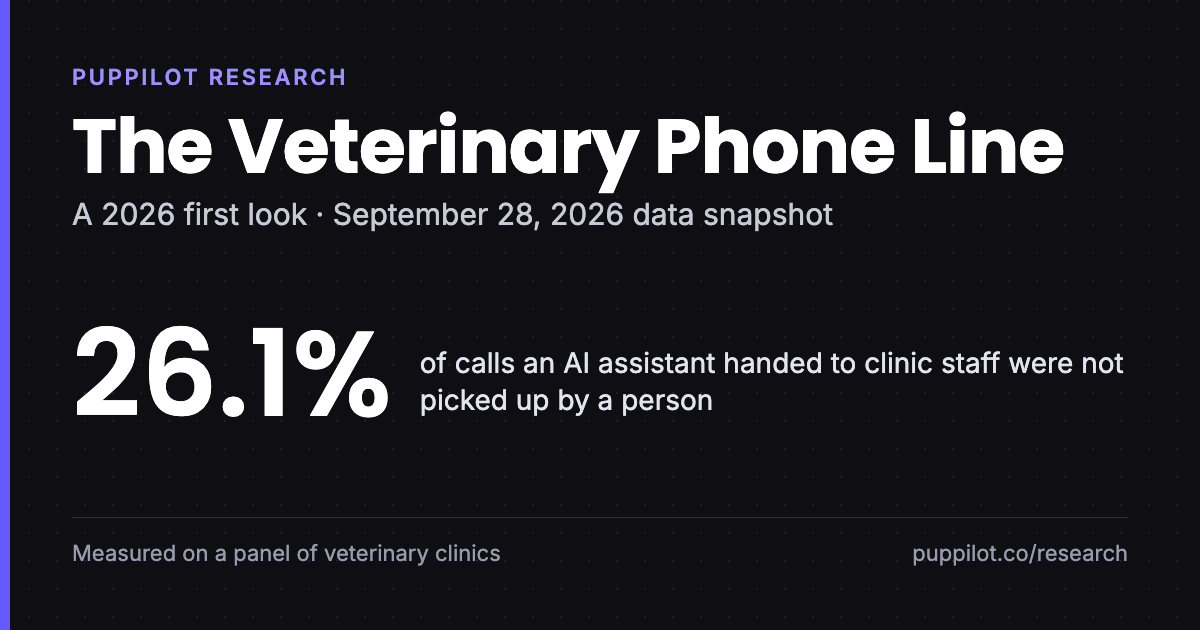
The data-centric reality is that most clinics are fumbling this catch on 30% or more of the plays.
The Data-Centric Problem: Where Your Bucket Leaks
When a prospective client calls, they are a "warm lead" of the highest possible value. They have a need, they've found you, and they have their phone in their hand, ready to give you their business. A manual phone system is a gauntlet designed to lose them.
Here is where, and how, your bucket is leaking.
1. The "Busy Signal" Leak (The Instant Loss) This is the most obvious leak. Your clinic is on its "lumpy demand" 8:00 AM Monday peak. All three of your human receptionists are on calls. A new client, whose cat is sick, calls. They get a busy signal. This is the 2024 equivalent of a "CLOSED" sign. They hang up and call your competitor. This is a 100% conversion failure.
2. The "Voicemail Void" Leak The caller gets through, but to a voicemail prompt: "We are busy assisting other clients..." This is the "kiss of death." A new caller sent to voicemail has been asked to do your intake work and wait; many simply won’t. They are not "impressed" that you are "assisting other clients." They are gone.
3. The "On-Hold Hang-Up" Leak (The Slow-Burn Loss) The call is answered by a stressed front desk staffer. "Can you hold, please?" The client is then dumped into an "on-hold" queue. Consumer patience in a digital world is thin: in the 2025 JAVMA secret-shopper study, 8.2% of booking attempts ended after more than five minutes on hold. The callers who stay past that point are annoyed — and the ones who don’t may still call your competitor. This is a "slow-burn" conversion failure.
In all three scenarios, you paid for that call. Your $5,000 budget worked. It made the phone ring. And your process failed to convert it.
Doing the Math: The Crippling Cost of a High CAC
This is where we must talk about the most important metric your marketing agency probably isn't showing you: Customer Acquisition Cost (CAC).
The formula is simple: CAC = (Total Marketing Spend) / (Number of New Clients Acquired)
A low CAC is good (it means you're efficient). A high CAC is bad (it means you're paying a lot for each client).
Your "leaky bucket" phone system is artificially inflating your CAC to catastrophic levels. Let's run a simple, conservative scenario.
- Your Marketing Spend: $5,000
- Leads Generated: Your agency "drives" 100 new client phone calls.
Scenario A: The "Perfect World" (0% Leak) In this magical world, you have a perfect system that answers 100% of calls and books 100% of the new clients.
- Marketing Spend: $5,000
- Clients Acquired: 100
- Your Customer Acquisition Cost (CAC): $50
- This is efficient. You are paying $50 to acquire a new client whose Lifetime Value (CLV) is $2,000 - $5,000. This is a home-run investment.
Scenario B: The "Real World" (A 30% Leak) This is the reality for most veterinary clinics. Your manual front desk is overwhelmed. Between busy signals, voicemails, and on-hold hang-ups, you lose 30% of the 100 calls you paid for.
- Marketing Spend: $5,000
- Clients Acquired: 70 (you lost the other 30)
- Your Customer Acquisition Cost (CAC): $71.43
Let's pause on this. This is the "hidden tax" on your inefficiency.
Your CAC is now 42% higher than it should be. You are paying $71.43 for the exact same client you could have acquired for $50.
But the real damage is far worse. Look at your $5,000 budget.
- $3,500 of your budget (70% of it) went to acquiring 70 clients.
- $1,500 of your budget (30% of it) was COMPLETELY, 100% WASTED.
You lit $1,500 on fire. You spent it to acquire nothing. Even worse, you spent $1,500 to send 30 new clients to your competitors. Your marketing budget is actively funding the growth of other clinics.
And this 30% "leak" is a conservative number for a clinic at its peak-time chaos.
The Flawed Diagnosis: "We Need Better Marketing" or "More Staff"
This is the point where the practice owner, frustrated with their $71.43 CAC (though they probably don't know the number), makes one of two critical mistakes.
Mistake 1: "We need a better marketing agency." You fire your agency and hire a new one. The new agency also spends $5,000 and "drives" 100 new calls. And you still miss 30 of them. Your CAC is still $71.43. You don't have a lead generation problem. You have a lead conversion problem. Pouring more water (a bigger budget) into a leaky bucket doesn't fix the problem; it just makes the leak (your wasted spend) bigger.
Mistake 2: "We need to hire more front desk staff." This is a financially unwinnable war. Your call volume is "lumpy." It floods at 8 AM and 5 PM. To truly handle that peak, you'd need to hire 5 receptionists. But then they would be over-staffed and doing nothing for the 6 hours in between. So, you're forced to staff for the average, which guarantees you will fail at the peak—which is exactly when your marketing is driving calls.
Hiring more people into a broken process doesn't fix the process; it just makes your chaos more expensive.
The Real Solution: Plug the Leak Before You Add More Water
You cannot fix a math problem with more people. You must fix it with a better system.
The only scalable, cost-effective, and data-centric way to ensure a 100% answer and conversion rate is to automate the catch. This is the precise, financial-survival case for vet AI automation.
An AI phone system is not just an "answering machine." It is a conversion machine.
- It Answers 100% of Calls: At your 8:00 AM peak, it can handle 100 simultaneous calls. Your "busy signal" and "voicemail" leaks are gone.
- It Never Puts a Client on Hold: The "on-hold hang-up" leak is gone.
- It Converts 24/7: It doesn't just "answer." It integrates with your PIMS and books the appointment on the spot, at 8 AM on Monday or 10 PM on a Saturday.
- It Tracks Everything: For the first time, you have real data. You can see how many calls came in, what they were for, and how many were booked. You can finally see your true call conversion rate.
The New Math: What Happens When the Leak Is Plugged
Let's re-run our numbers one last time. You are still spending $5,000. Your agency is still driving 100 calls. But now, you have an AI "bucket" that has no leaks.
Scenario C: The Automated, 0% Leak World
- Marketing Spend: $5,000
- Clients Acquired: 98 (Let's be realistic and say 2% drop off for other reasons).
- Your Customer Acquisition Cost (CAC): $51.02
You have just made your marketing spend 40% more efficient.
But the real, mind-blowing ROI is in the lost revenue you recaptured.
- Clients "Saved": 28 (The 98 you booked - the 70 you used to book)
- Client Lifetime Value (CLV): $2,000 (ultra-conservative)
- Future Revenue Recaptured: 28 x $2,000 = $56,000
Your AI automation system—which costs a tiny fraction of this—didn't just "save" you $1,500 in wasted ad spend. It unlocked $56,000 in future revenue that you were previously handing to your competitors.
Conclusion: Stop Buying Water. Fix the Bucket.
Your marketing budget is not the problem. Your marketing agency is (probably) not the problem.
Your process is the problem. Your manual, leaky-bucket phone system is actively sabotaging your growth, incinerating your marketing dollars, and creating a sky-high CAC.
The single most impactful, highest-ROI marketing decision you can make this year is to stop buying more ads. The first dollar you spend should be on plugging the leak. Fix your conversion point. Automate your front desk.
Only then should you "make it rain." Because for the first time, you'll have a bucket that can actually hold the water.
Related: The Compliance Gap: How Manual Reminders Are Costing Your Practice 30% of Its Preventative Care Revenue; ‘I Was on Hold for 10 Minutes’: How Your Phone Wait-Time Is Destroying Your Online Reputation; and The ‘Note Lag’ Liability: Data Shows 48-Hour Charting Delays Increase Your Malpractice Risk.
Frequently Asked Questions (FAQ)
Q: "How do I even know what my current call conversion rate is?" A: This is the scariest part: if you have a traditional, manual phone system, you can't. You have no data. The missed calls, busy signals, and on-hold hang-ups are invisible to you. The only way to get this data is to install a modern, data-centric AI phone system that provides a dashboard with your "call volume," "answer rate," "abandonment rate," and "call intent."
Q: "Isn't my marketing agency supposed to track this?" A: Your agency can only track the calls (the leads). They can't track what happens after the call connects. They have no idea if your front desk answered it, put them on hold, or sent them to voicemail. They are blind, and they are assuming you are converting 100% of the leads they send, which is why their projections and your reality never match.
Q: "What's a 'good' call conversion rate for a vet clinic?" A: With a manual system, anything over 70% is (sadly) considered decent. But this is the wrong question. With a modern AI automation system, the target is 100% answer rate, and a 95%+ booking conversion rate for new, qualified clients. The new technology has completely changed the benchmark.
Q: "Will this automation really work if the new client has a complex medical question?" A: This is the beauty of a smart AI system. It's not a "dumb" phone tree. It's designed for triage. It understands, "I need to book a vaccine" (which it does) vs. "My dog can't breathe" (which it immediately escalates, routing the call to a human or an emergency line). It automates the 80% of "simple" calls to free up your human staff for the 20% of "complex" calls, ensuring every client gets the right level of care, immediately.
Related: AI Appointment Scheduling for Veterinary Clinics: The Future of Seamless Vet Visits, AI Crash Course for Veterinarians: Part 1 of 4, AI Crash Course for Veterinarians: Part 2 of 4 Also see: AI Crash Course for Veterinarians: Part 3 of 4, AI Crash Course for Veterinarians: Part 4 of 4, AI in Animal Healthcare: From Campus Labs to Clinic Floors.