Dog Age Calculator
Convert your dog's age to human years using the latest epigenetic research. Not all dogs age the same — size matters.
Your Dog
At this age, your dog has the physical maturity of a human in their late 40s to 50s. Consider annual wellness screenings.
Your Medium dog through the years
| Dog Age | Human Equivalent | Life Stage |
|---|---|---|
| 6 months | ~8 years | Puppy |
| 1 year | ~15 years | Young Adult |
| 2 years | ~40 years | Young Adult |
| 3 years | ~46 years | Young Adult |
| 5 years | ~54 years | Mature Adult |
| 7 years | ~59 years | Mature Adult |
| 10 years | ~64 years | Senior |
| 13 years | ~68 years | Geriatric |
How We Calculate Your Dog's Age in Human Years
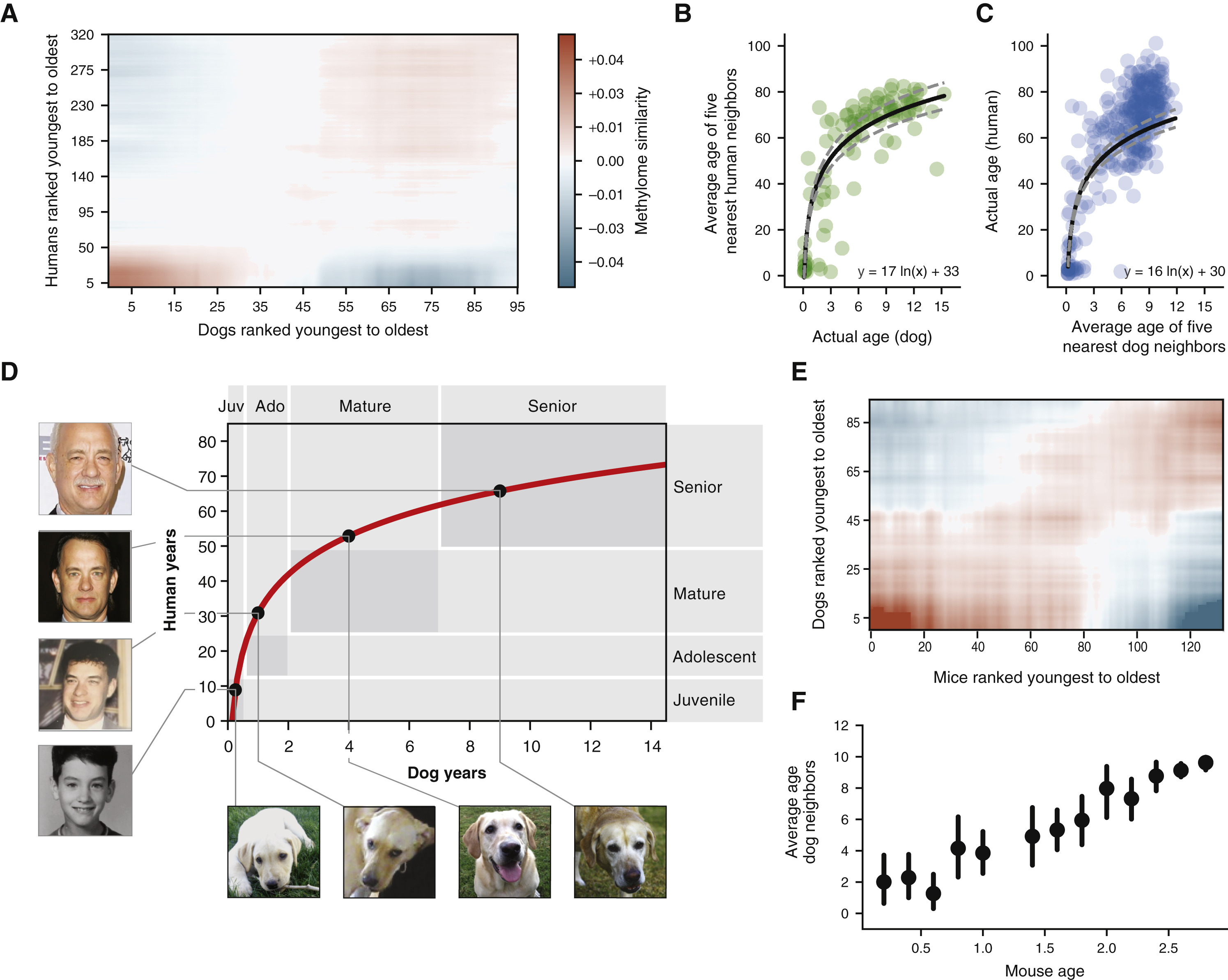
The popular "multiply by 7" rule is a myth. Dogs don't age at a constant rate — they mature rapidly in their first two years, then aging slows down. Our calculator uses a piecewise formula that combines developmental milestones from AAHA and AVMA guidelines with the epigenetic aging formula published by Wang et al. (2020) in Cell Systems.
The Science Behind Dog Aging
Researchers at UC San Diego analyzed DNA methylation patterns (epigenetic clocks) in 104 Labrador Retrievers and 320 humans. They discovered that dogs age in a logarithmic pattern — very fast at first, then gradually slowing. The core formula is: human age = 16 × ln(dog age) + 31. Because this was calibrated on Labradors (a large breed), we apply size-based multipliers for smaller and larger breeds.
Why Size Matters
Small dogs live significantly longer than giant breeds. A toy poodle might live 14–16 years, while a Great Dane's average lifespan is only 7–8 years. This size-lifespan tradeoff was studied extensively by Kraus et al. (2013), who found that large dogs age at an accelerated rate compared to smaller dogs. Our calculator adjusts for this with breed-specific multipliers.
More Pet Tools
- Puppy Weight Calculator — Predict your puppy's adult size
- Cat Age Calculator — Convert cat years to human years
- View All Free Pet Tools
Sources & Methodology
- Wang, T. et al. (2020). "Quantitative Translation of Dog-to-Human Aging by Conserved Remodeling of the DNA Methylome." Cell Systems, 11(2), 176-185.e6
- AAHA Senior Care Guidelines for Dogs and Cats (aaha.org)
- AVMA life stage classifications (avma.org)
- Kraus, C. et al. (2013). "The size-life span trade-off decomposed: why large dogs die young." American Naturalist, 181(4), 492-505
Age conversion is approximate. The logarithmic formula is based on epigenetic research (Wang et al., 2020, UC San Diego) validated on Labrador Retrievers, with size adjustments based on veterinary lifespan data. Individual dogs age differently based on breed, genetics, nutrition, and health. Your veterinarian is the best resource for assessing your dog's health stage.
Medical Disclaimer: The information provided on this page is for general informational and educational purposes only and is not intended as a substitute for professional veterinary advice, diagnosis, or treatment. Always seek the guidance of a qualified, licensed veterinarian with any questions you may have regarding your pet's health or a medical condition. Never disregard professional veterinary advice or delay seeking it because of something you have read on this website. Use of this website does not create a veterinarian-client-patient relationship (VCPR) between you and PupPilot or any veterinary professional. If you believe your pet may have a medical emergency, contact your veterinarian or local emergency animal hospital immediately.
Dog Age Calculator FAQ
How do you convert dog years to human years?
The old "multiply by 7" rule is outdated. Modern veterinary science uses a piecewise approach: the first year of a dog's life equals about 15 human years, the second year adds about 9 more (total 24), and after age 2, each additional year is calculated using a logarithmic formula based on epigenetic (DNA methylation) research. Size matters too — small dogs age more slowly than giant breeds.
Why does size affect dog aging?
Larger dogs age faster and have shorter lifespans than smaller dogs. A Great Dane is considered senior by age 5–6, while a Chihuahua may not reach senior status until 10–12 years old. The exact biological mechanism is still being studied, but it's related to faster growth rates and higher metabolic demands in larger breeds (Kraus et al., 2013, American Naturalist).
What is the epigenetic dog age formula?
The formula human_age = 16 × ln(dog_age) + 31 was published by Wang et al. in 2020 in Cell Systems. It was derived from DNA methylation analysis comparing 104 Labrador Retrievers to 320 humans. It captures the non-linear aging pattern: dogs mature very quickly in their first few years, then aging slows down.
When is a dog considered a senior?
It varies by size. Small and toy breeds: around 10–12 years. Medium breeds: 8–10 years. Large breeds: 7–8 years. Giant breeds: as early as 5–6 years. These life stage classifications come from the AAHA Senior Care Guidelines.
Is a 1-year-old dog really like a 15-year-old human?
Approximately, yes. By their first birthday, most dogs are sexually mature, have their adult teeth, and have reached near-adult physical development — similar developmental milestones to a human teenager. An 8-week puppy is roughly equivalent to a 9-month-old human infant in development.