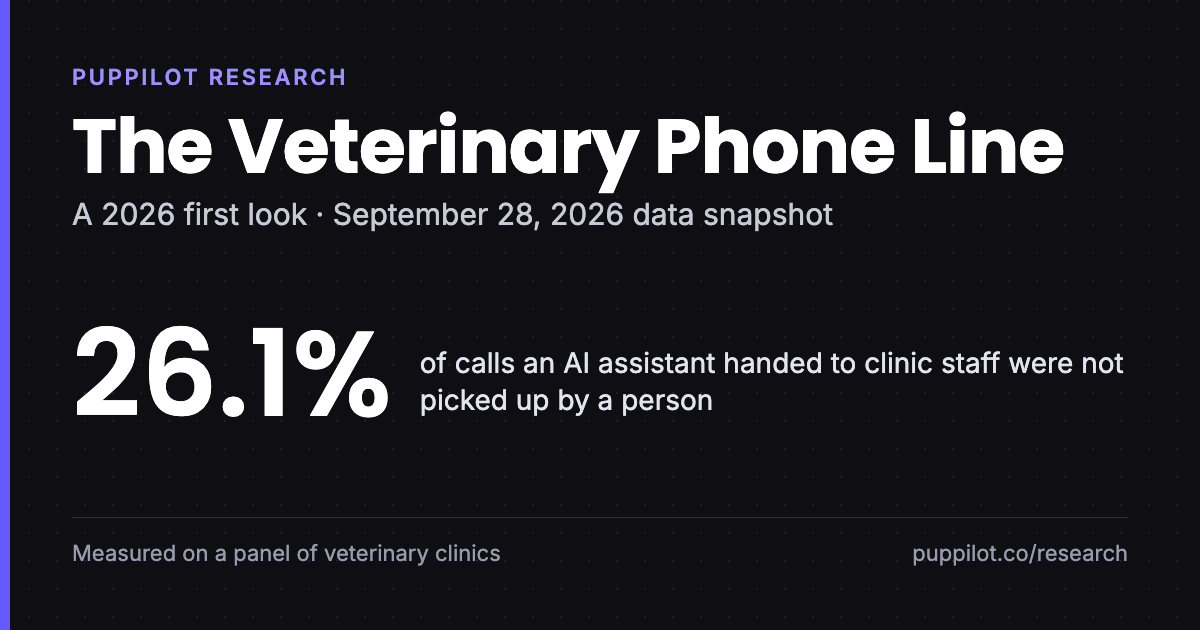
For routine requests, ask your clinic when it prefers calls that need a staff member. In this panel, Monday carried 21.3% of weekly calls, and 35.2% of transfers at 1 p.m. did not reach a person. Those patterns identify busy or difficult periods; they do not establish one best calling time for every practice.
The findings here concern routine, nonurgent communication. They do not establish a safe waiting period for a health concern. For a medical concern, follow your veterinary practice's instructions for contacting the team or its designated urgent-care service rather than waiting for a quieter hour.
Is Monday a busy day to call?
Monday accounted for 21.3% of weekly call volume in the study panel. That was the largest daily share.
It is reasonable to ask your practice whether another day works better for an administrative request without a deadline. But the study does not show that every Monday call involves a long wait, or that every practice follows the same pattern.
Your clinic may have different appointment hours, staff coverage, or ways to handle requests. Its own instructions should take priority over a general pattern from other practices.
Is lunchtime a quieter time to reach someone?
Not necessarily. In the study's transfer analysis, 32.9% of handoffs to staff at noon and 35.2% at 1 p.m. were not answered by a person within the configured ring window. At 8 a.m., the share was 19.7%.
These were calls an assistant had already answered before attempting to connect the caller to clinic staff. They were not all incoming calls, and the figures do not show why a person did not answer.
They do suggest that “fewer people may be calling now” and “someone will be available now” are different ideas. Ask the practice when it prefers to receive routine requests that need a staff member.
Does that make the afternoon the best time?
The data do not support a universal afternoon recommendation. Although the largest arrival peak was at 11 a.m., unanswered-transfer shares remained between 27.4% and 30.0% in the hours from 2 through 5 p.m.
Nor does Sunday's small share of calls establish that Sunday is a good time to contact your clinic. A small number of calls may reflect limited opening hours rather than easy access to the team.
For a routine request, a more useful question is: “When should I call about this, or is there another channel you prefer?” That lets the practice guide you to the right time and method for the work you need.
What information should you have ready?
A clear description of the request gives the team a useful place to start. You might say that you want to arrange an appointment, ask about the status of a prescription request, or obtain a copy of records. Have the patient name and your contact details available, and follow the practice's instructions about any other information it needs.
When a reply is expected, confirm the next step and how the team will contact you. Avoid assuming that leaving a message means an appointment is booked or a request has been approved.
What is this advice based on?
The findings come from a March–September 2026 panel of veterinary clinics on PupPilot, covering more than 100,000 inbound calls overall. The timing and transfer figures use different subsets of those calls and are not estimates for every veterinary practice.
The clearest takeaway is to use the clinic's own guidance. General patterns can help you ask a better question about routine communication; they should not replace the practice's opening hours, preferred request process, or instructions for urgent concerns.
The research behind this piece: How often does a call handed to the front desk go unanswered? · The veterinary front-desk phone workload: how many calls, when, and how long?
Cite this: PupPilot Research. “When is the best time to call your vet?” The Veterinary Phone Line: a 2026 first look. September 28, 2026 data snapshot. https://www.puppilot.co/blog/best-time-to-call-your-vet
About this research: PupPilot Research examines call records from a panel of veterinary clinics using PupPilot. The findings describe observed calls and requests within that panel.